quicklinks
Thank you! Your submission has been received!
Oops! Something went wrong while submitting the form.
Thank you! Your submission has been received!
Oops! Something went wrong while submitting the form.
As technology continues to transform the way we live and work, schools are increasingly preparing students for a future that will require more than subject knowledge alone.
Universities and employers are looking for graduates who can think critically, solve complex problems, collaborate effectively, communicate clearly, and adapt to change.
This is where STEAM education comes in.
Rather than teaching subjects in isolation, STEAM encourages students to make connections across disciplines and apply their learning to real-world challenges. It is an approach that combines academic rigor with creativity, helping students develop the skills needed to thrive in an increasingly interconnected world.
STEAM stands for:
The addition of the Arts is what distinguishes STEAM from STEM.
While scientific and technical knowledge remain essential, innovation often happens when analytical thinking is combined with creativity, communication, design, and human-centered problem-solving.
STEAM education reflects the reality that today's most important challenges rarely belong to a single subject area.
The careers of tomorrow will demand a combination of technical expertise and transferable skills.
Students need to learn how to:
STEAM education develops these competencies by encouraging inquiry, experimentation, design thinking, and interdisciplinary learning.
Rather than simply memorizing information, students learn how to apply knowledge in meaningful contexts.
One of the defining characteristics of STEAM education is its interdisciplinary approach.
Students may use mathematics to analyze scientific data, apply coding skills to engineering challenges, or combine research, design, and communication to present solutions to real-world problems.
This mirrors the way professionals work in fields ranging from technology and medicine to sustainability, business, and design.
By making connections across subjects, students develop a deeper understanding of concepts and a stronger ability to transfer learning from one context to another.
International schools provide a particularly strong environment for STEAM learning.
Students work alongside peers from diverse cultural backgrounds, bringing different perspectives to discussions and projects.
This encourages:
For internationally mobile families, these experiences help prepare students not only for university, but also for life in an increasingly global world.
One of the greatest strengths of STEAM education is that it allows students to develop their own interests and strengths.
At the American School of Paris, students can build highly personalized learning pathways through a combination of academic courses, electives, and enrichment opportunities.
For example, a student interested in engineering and technology might combine:
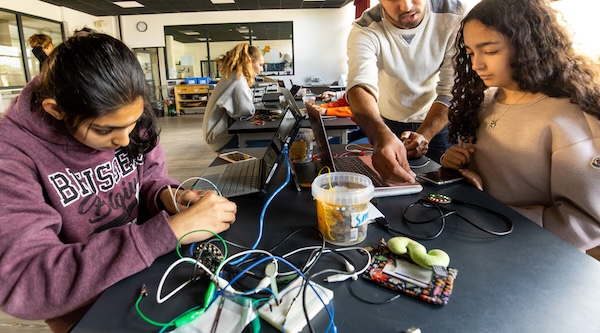
Students in Interactive Design explore coding, electronics, digital fabrication technologies, 3D printing, laser cutting, and computer-aided design, gaining practical experience with tools used in professional design and engineering environments.
Students interested in scientific research and sustainability may pursue:
while applying their learning to real-world environmental questions and global challenges.
Those with a passion for robotics and innovation can further develop their skills through programs such as FIRST Lego League, where students design, build, and program robots while working collaboratively to solve engineering challenges.
These opportunities allow students to move beyond traditional subject boundaries and explore areas that genuinely inspire them.
The "A" in STEAM is not an addition for balance; it is a critical component of innovation itself.
Creative thinking helps students generate new ideas, communicate complex concepts, and approach problems from different perspectives.
At ASP, students can complement their scientific and technical interests through a rich range of artistic opportunities, including:
This combination of creativity and analytical thinking helps students develop a broader skill set and a deeper understanding of how innovation happens in the real world.
Universities increasingly value students who demonstrate both academic excellence and intellectual curiosity.
A student who combines advanced coursework in mathematics, science, or computer science with creative, leadership, or service-oriented experiences often develops a more distinctive profile.
STEAM education encourages exactly this type of balanced development.
It helps students identify their interests, explore potential career pathways, and build the confidence to tackle complex challenges.
At ASP, this process is further supported by personalized academic advising and university counseling, helping students align their course choices with their long-term goals.
The goal of STEAM education is not simply to prepare students for a specific profession.
It is to help them become adaptable thinkers, creative problem-solvers, and engaged global citizens.
By integrating science, technology, engineering, arts, and mathematics, students develop the knowledge, mindset, and skills needed to succeed in a rapidly changing world.
Discover STEAM learning at ASP
At the American School of Paris, STEAM learning extends across advanced academic courses, interdisciplinary projects, arts programs, and extracurricular opportunities.
Students are encouraged to challenge themselves, explore their passions, and build personalized pathways that support both university preparation and lifelong learning.
👉 Explore our Course Catalog
👉 Discover our Arts, Activities, and Athletics programs
STEM focuses on Science, Technology, Engineering, and Mathematics. STEAM adds the Arts, recognizing the importance of creativity, communication, and design thinking alongside technical knowledge.
STEAM education helps students develop critical thinking, creativity, collaboration, and problem-solving skills that are increasingly important for university studies and future careers.
Examples include coding, robotics, engineering projects, scientific research, design challenges, digital fabrication, visual arts, and interdisciplinary problem-solving activities.
STEAM helps students apply knowledge across disciplines, adapt to new challenges, think creatively, and develop the skills needed in a rapidly evolving global economy.