
quicklinks
Thank you! Your submission has been received!
Oops! Something went wrong while submitting the form.
Thank you! Your submission has been received!
Oops! Something went wrong while submitting the form.
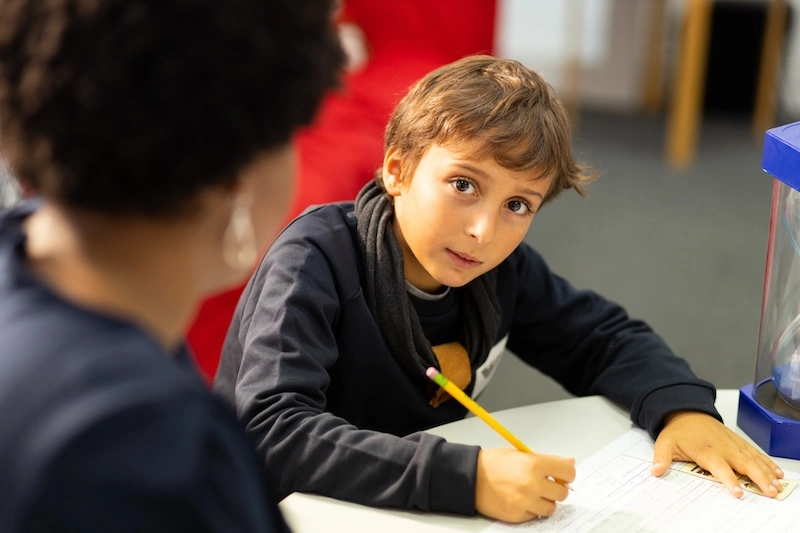
Moving to a new country is an exciting adventure, but it also comes with a fair share of uncertainty. Parents naturally spend time thinking about practical questions such as where to live, how to organize daily life or which neighborhood will feel like home. Yet, behind those decisions lies another question that often matters even more:
Will my child be happy?
The reassuring answer is that there is no single type of child who thrives in an international school. Some children are naturally curious and eager to meet new people. Others prefer to observe before joining in. Some love solving mathematical puzzles, while others lose track of time in an art studio or on an athletic field. Every child arrives with a unique personality, different interests and their own way of learning.
What makes the difference is not whether a child fits an international school. It is whether the school creates an environment where every child has the opportunity to grow with confidence.
Parents sometimes worry that international schools are designed for particularly outgoing, adventurous or academically gifted children. In reality, the opposite is often true.
The best international schools recognize that children develop at their own pace. Confidence cannot be rushed, curiosity cannot be forced and friendships rarely happen on a schedule. Each child needs time, encouragement and opportunities to discover what motivates them.
A student who is initially quiet may gradually become more confident after joining a theatre production. Another who has never considered engineering might discover a passion for robotics through an after-school club. A child who feels hesitant during their first weeks can quickly flourish once they have found a group of friends who share the same interests.
Growth rarely follows a straight line. It happens through hundreds of small experiences that, together, help children better understand who they are and what they are capable of.
One of the greatest strengths of an international school is the diversity of perspectives children encounter every day.
Sharing a classroom with classmates from different countries, cultures and languages naturally encourages students to ask questions, listen carefully and discover new ways of seeing the world. Conversations that begin with simple topics often become opportunities to understand different traditions, experiences and viewpoints.
This daily exposure to diversity helps children develop qualities that extend far beyond academic knowledge. They become more comfortable communicating with people from different backgrounds, more open to unfamiliar ideas and more adaptable when faced with change.
These experiences are increasingly valuable in a world where collaboration across cultures has become part of everyday life.
Parents often compare schools by looking at academic programs, facilities or university destinations. Those elements certainly matter, but they only tell part of the story.
Children spend their days with teachers, coaches, counselors and support staff. These are the people who celebrate their successes, encourage them when they face difficulties and help them develop the confidence to keep trying, even when something feels challenging.
At the American School of Paris, experienced teachers, counselors, coaches and support staff work closely together to understand each student as an individual. They know that every child learns differently and that building confidence requires patience, trust and genuine relationships.
When students feel genuinely known and understood, they are more willing to participate, ask questions and gradually step outside their comfort zone.
For many families, starting at a new school is about much more than finding the right curriculum. It is about finding a place where children feel welcomed, accepted and comfortable enough to be themselves. That sense of belonging rarely happens by chance.
It grows through the small moments that make a new environment feel familiar: being greeted by name in the morning, sharing lunch with new classmates, discovering common interests or simply knowing there is always someone to turn to when aquestion arises.
At the American School of Paris, helping new students settle in is an important part of the school experience. Orientation programs, student buddies and a welcoming parent community help families build connections from the very beginning, making what could feel like a daunting transition a much smoother experience.
When children feel that they belong, they are free to focus on what matters most: learning, exploring and building meaningful friendships.
Ask most adults how they discovered their passions, and few will tell you they had everything figured out at age eight. Children grow by trying new things. Sometimes a single project, conversation or inspiring teacher can reveal an interest that shapes the years to come. That is why the breadth of a school's learning experience matters so much.
At ASP, students gradually build their own educational journey through a broad academic program that combines rigorous foundations with opportunities to explore sciences, mathematics, languages, humanities, innovation and design, the arts and physical education. Rather than encouraging every student to follow exactly the same path, the curriculum is designed to help each child discover where their interests lie while developing the knowledge and skills they will need for the future.
As children grow older, those opportunities become increasingly personalized. Some choose to deepen their interest in science through Advanced Placement courses, while others explore literature, languages, economics, visual arts or computer science. Each experience contributes to building confidence because students are learning about themselves as much as they are learning about academic subjects.
Some of the most memorable moments in a child's education happen long after the last class of the day.
It might be rehearsing for a theater performance, competing in a robotics challenge, playing in a basketball tournament or working alongside classmates on a community service project. These experiences often become defining moments because they allow children to discover talents that are difficult to reveal within the boundaries of a traditional classroom.
Beyond the skills themselves, extracurricular activities teach something equally valuable. Students learn to collaborate, persevere through setbacks, take initiative and celebrate the success of others. They begin to understand that personal growth often happens just outside their comfort zone.
With more than 60 extracurricular clubs, a vibrant arts program and one of the largest athletics programs among international schools in the Paris region, ASP encourages every student to explore new interests throughout their school journey. There is no expectation that every child will excel in every activity. The goal is simply to give each student enough opportunities to discover what excites them and where they feel they truly belong.
There is no checklist that determines whether a child is "made" for an international school. Some arrivefull of confidence, ready to embrace every new opportunity. Others need a little more time before they feel comfortable enough to raise their hand in class, join a sports team or introduce themselves to new friends. Both journeys are equally valuable.
What matters is finding a school that sees children as individuals, recognizes their potential and gives them the confidence to grow at their own pace.
At the American School of Paris, that philosophy shapes every aspect of school life. From dedicated educators and a broad academic program to a vibrant student community and a wealth of opportunities beyond the classroom, every experience is designed to help students discover who they are and who they can become.
Ultimately, choosing a school is about much more than academics. It is about finding a place where your child feels confident enough to ask questions, curious enough to explore new ideas and supported enough to develop their own sense of identity and purpose. For many families, that is what makes all the difference.
Absolutely. Every child settles into a new environment at their own pace. While some quickly make new friends, others simply need a little more time to build confidence. A caring school community, supportive teachers and opportunities to connect through buddy programs, clubs and shared activities help children feel comfortable enough to be themselves and gradually find their place.
Not necessarily. The American School of Paris welcomes students with a range of English language abilities. Dedicated English language support helps children gain confidence while continuing to value and develop their home language. For many international families, becoming bilingual or multilingual is part of the journey rather than a prerequisite.
Starting at a new school is a transition for the whole family. Orientation programs, student buddies and parent ambassadors help newcomers quickly feel part of the community, making those first weeks smoother and giving children the confidence to focus on learning, making friends and enjoying their new environment.
There is no single profile of a child who thrives in an international school. The most important factor is finding a school where your child feels supported, encouraged and inspired to explore their interests. When children feel known,challenged and valued for who they are, they are far more likely to develop the confidence to flourish, both academically and personally.