quicklinks
Thank you! Your submission has been received!
Oops! Something went wrong while submitting the form.
Thank you! Your submission has been received!
Oops! Something went wrong while submitting the form.
Choosing a kindergarten is one of the first major decisions families make in their child’s education. For international families in Paris, or for those seeking a more global approach, an international kindergarten can offer a unique and powerful start.
From early bilingual exposure to a more holistic approach to learning, international early childhood programs are designed to support both academic and personal development from a young age.
Here are five reasons why many families choose an international kindergarten.
One of the biggest advantages of an international kindergarten is early immersion in English or a bilingual environment.
At this stage, children naturally absorb languages through interaction, play, and daily routines. This makes early childhood the ideal time to develop strong language foundations without pressure.
Rather than formal language instruction, children learn organically by:
This early exposure builds confidence and fluency over time, creating a strong base for future academic success.
International kindergartens bring together students from diverse cultural backgrounds, creating a naturally multicultural environment.
Children learn to interact with peers from different countries, develop curiosity about the world and build empathy and openness.
This global exposure helps shape internationally minded students who are comfortable navigating different cultures — an essential skill in today’s world.
International preschool programs, particularly those inspired by the American education system, emphasize the development of the whole child. This includes social and emotional growth, creativity and self-expression, as well as collaboration and communication skills.
Learning is not limited to academic outcomes. Instead, children are encouraged to explore, ask questions, and develop confidence in a supportive environment.
This approach helps children build strong foundations not only for school, but for life.
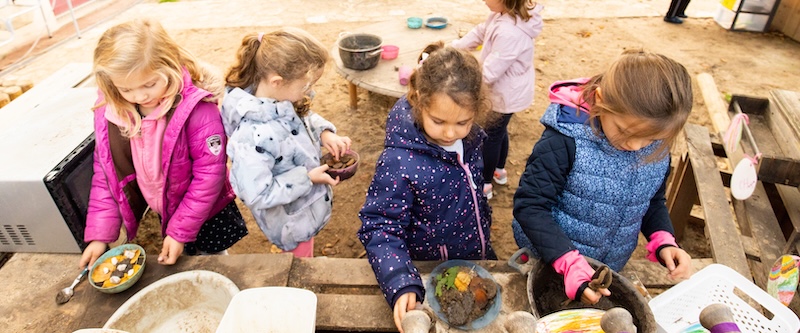
In an international kindergarten, play is not just a break from learning — it is a core part of the learning process.
Through play-based learning, children develop problem-solving skills, language abilities, motor skills and social interactions.
Activities such as outdoor exploration, creative arts, and hands-on projects allow children to engage actively with their environment.
This method encourages curiosity and a love of learning from an early age.
Explore our outdoor learning spaces →
In leading international schools, learning does not stop when the school day ends.
At the American School of Paris, students can extend their learning through a wide range of after-school activities designed to nurture curiosity, creativity, and confidence from an early age.
Even at the kindergarten and Lower School level, children can explore interests through activities such as:
These activities are not just extracurricular: they play a key role in helping children discover their interests early, build confidence in new environments and develop a wide range of skills beyond academics.
This extended learning environment allows each child to begin shaping their own path, even at a young age, and contributes to a more personalized and enriching educational experience.
Starting in an international kindergarten can provide a smooth transition into an international school system. Children become familiar with English as a language of instruction, international teaching methods, and classroom dynamics focused on participation and inquiry.
This continuity is particularly valuable for families considering long-term international education pathways, whether through the American system, IB programs, or other global curricula.
For families living in or moving to Paris, choosing an international kindergarten is often about more than language. It’s about giving children confidence in a multicultural environment, strong communication skills and a positive first experience of school.
Every child is different, and the best choice depends on your family’s goals, language background, and educational plans.
At the American School of Paris, our Early Childhood program is designed to support children aged 3 to 6 in a nurturing, engaging, and international environment.
Through play-based learning, outdoor education, and a strong focus on social development, students begin their journey in a way that builds confidence, curiosity, and a lifelong love of learning.
Learn more about our Early Childhood program →
Schedule a visit to discover our campus →
An international kindergarten is a preschool program that follows an international curriculum, often taught in English, and welcomes students from diverse cultural backgrounds.
Bilingual kindergartens help children develop language skills early, improve cognitive flexibility, and build confidence in communication.
Most international schools welcome children from age 3 in early childhood or kindergarten programs.